| At its peak in the sixteenth century the Ottoman system was highly efficient. But it also contained crucial weaknesses, notably the system of succession. In nomadic societies the absence of a fixed mode of succession has a sound Darwinian rationale: after a struggle with his peers, a chief will emerge who is fittest to lead his tribe. Transferred to the center of an imperial system, the result will be civil war. |

Abdul Hamid II was the last Ottoman sultan to wield effective power over the Empire. An absolute monarch and
opponent of political liberalization, he nonetheless encouraged educational, legal, and economic reforms. |
After a series of fratricidal struggles, the Ottomans dealt with the problem of the succession by confining the sultan’s male relatives to the palace’s Inner Courtyard or harem, thereby preventing future sultans from acquiring vital knowledge of military and secular affairs. From the seventeenth century the Ottoman sultans, who came to power as a result of “Byzantine” maneuvers and harem intrigues, lacked experience in the field and familiarity with the realities of politics. The power of the state and the army held up briefly under ruthless viziers such as Mehmed Koprulu (r. 1656–61), son of an Albanian Christian, and his son Ahmed (r. 1661–76), allowing further expansion north of the Crimea and (after Ahmed’s death) even a second siege of Vienna (1683). The process of decline, however, proved irreversible. The influx of Spanish silver from the Americas created a massive inflation problem, undermining the commercial classes and the ability of government to pay for troops whose modern weaponry (muskets and gunpowder) required cash rather than booty. Provincial governors and local magnates gained power at the expense of the center, hiring private armies or raising taxes for themselves. The Janissaries, who had evolved into a privileged body within the state, became enmeshed in large-scale nepotism and misrule. Land concessions that should have nurtured agriculture degenerated into tax-farms, driving cultivators off the land, and creating gangs of rural bandits or urban migrants who drifted into cities already overcrowded and subject to famine, plague, and disorder. The millet system, which allowed the Christian and Jewish communities (and in Iraq the Shiite) a high degree of administrative autonomy, undermined the legitimacy of the state by privileging Western traders and encouraging Greek and Balkan Christians to look toward the Empire’s enemies in Russia and Western Europe for inspiration and support. Internally decentralized, the Empire proved no match for the rising powers of Europe, whose military and economic systems were beginning to benefit from the revolution in scientific thought. During the last two decades of the seventeenth century, the European powers made significant advances at the Empire’s expense. Between 1684 and 1687 the Habsburgs took most of Hungary north of the Danube and took Serbia in 1689. The Venetians seized Dalmatia and southern Greece (Morea). Poland invaded Podolia, and the Russians, under the newly modernized army of Peter the Great, took Azov in the Crimea. Although the Ottomans regained some of these territorial losses during the first half of the eighteenth century, in the longer term they were unable to stem the tide of Russian advance. In 1768 the Russians began a new campaign, occupying Moldavia and Wallachia (modern Romania) and the Crimea. Under the humiliating terms of the treaty of Kuchuk Kaynarca (1774) the Ottomans were obliged to allow Russia a foothold on the Black Sea, as well as freedom of navigation and commerce, with access to the Mediterranean and to overland trade in the Empire’s Asian and European provinces. Although Moldavia and Wallachia remained technically under Ottoman suzerainty, the increased autonomy they were granted laid them open to Russian manipulation. Under Russian pressure a clause permitting the erection of a Russian church in Istanbul would be converted into a general right of Russian intervention on behalf of all the sultan’s Orthodox Christian subjects.
|
 Ottoman Empire Ottoman Empire |
| The flow of ideas that followed in the wake of European victories would prove even more devastating than military defeats. Napoleon Bonaparte’s brief occupation of Egypt in 1798 planted the seeds of modern scientific thought and revolutionary change in the Empire’s wealthiest (but most neglected) province. By defeating the neo-mamluk amirs who governed Egypt under Ottoman authority, Napoleon opened the way for penetration of Western ideas under the modernizing dynasty of Mehmed Ali (r. 1805–48), an Albanian officer who seized power in 1805, making himself an independent ruler in all but name. The colonial ambitions of a restored French monarchy led to the loss of Algeria from 1830 and the establishment of a protectorate in Tunisia (1881). The winds of nationalism that tore through Europe in the wake of the French Revolution reached the Christian communities in the Balkans, starting with the Serbian revolt of 1804–13 and the Greek war of independence (1821–29). They culminated in the treaty of San Stefano in 1878, by which the Ottomans were forced to concede the independence of Bulgaria, Serbia, Romania, and Montenegro. The final dismemberment of the Empire was only postponed because of rivalries between the European powers, with Britain and France propping up the “sick man of Europe” against Russia in the Crimea (1854–56) while Austria competed with Russia for ascendancy in the Balkans. In 1911, Italy invaded Tripoli and Cyrenaica, forcing the Ottomans to concede their suzerainty. In 1912, the combined Balkan powers (Serbia, Bulgaria, Greece, and Montenegro) took all the remaining Ottoman territories in Europe, except for a strip of land around Istanbul, before arguing among themselves. In August 1914 the rivalries between the European powers in the Balkans erupted into a worldwide war, with the Ottoman Empire ranged alongside Austria and Germany against Britain, France, Italy, and Russia. The defeat of the Central Powers in 1918, the abdication of the sultan in 1922, the abolition of the caliphate in 1924, as well as the exchange of populations between Turkey and Greece in 1921 brought the Ottoman Empire to its end. |
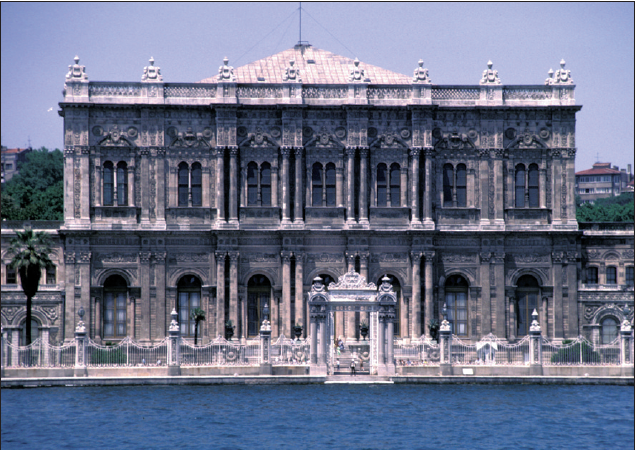
The Dolmabahçe Palace, Istanbul. The classical Venetianstyle facade of this palace, like others built for the Ottoman sultans in the nineteenth century, reveals change in cultural orientation, as they abandoned their former seclusion and displayed their power like European monarchs.
|
| Back to Table of Contents |
|
