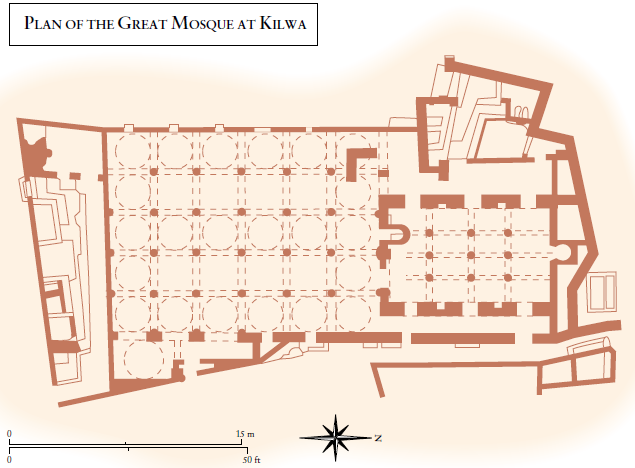
 The southernmost outpost of Dar al-Islam until modern times, Kilwa had a population of about 10,000 in 1505, when the Portuguese took the island by storm. The first Muslim occupants were mariners and merchants from the Persian Gulf who settled around AD 800. The southernmost outpost of Dar al-Islam until modern times, Kilwa had a population of about 10,000 in 1505, when the Portuguese took the island by storm. The first Muslim occupants were mariners and merchants from the Persian Gulf who settled around AD 800. |
From the time of the ancient pharaohs the Upper Nile regions of East Africa had belonged to the same cultural universe as Egypt. Ethiopia was Christianized by Coptic missionaries from the fourth century, and according to the earliest Islamic sources, the Christian Negus gave refuge to a group of persecuted Muslims from Mecca even before the Hijra. The Arab conquerors of Egypt reached Aswan in 641 and for centuries continued to move southward, giving the Upper Nile region its predominantly Arabic character. The Funj sultanate, which maintained a monopoly on the gold trade that lasted until about 1700, was created by herders moving downstream along the Blue Nile. It consolidated the Arabic influence by attracting legal scholars and holy men (known locally as faqis) from Egypt, the Maghreb, and Arabia.
|
| The Arab character of East African Islam was reinforced by the proximity of the coastal regions to the Hejaz and Yemen. From an early period Somali cattle-breeders acquired the most prestigious of all Islamic lineages in the form of Quraishi pedigrees, a trend that would emerge among other religious and tribal leaders. While Arabic and—in some cases—Persian brought by mariners retained their prestige as the language of “True Islam,” vernacular languages developed rich oral literatures that would eventually acquire written form. The first Swahili text dates from 1652. The Swahili culture that dominates the thousand-mile coastal strip from Mogadishu to Kilwa is the fruit of many centuries of interaction between the ideas brought by Arab-Persian merchants, traders, and settlers, and the indigenous peoples of the eastern seaboard with whom they intermarried. |
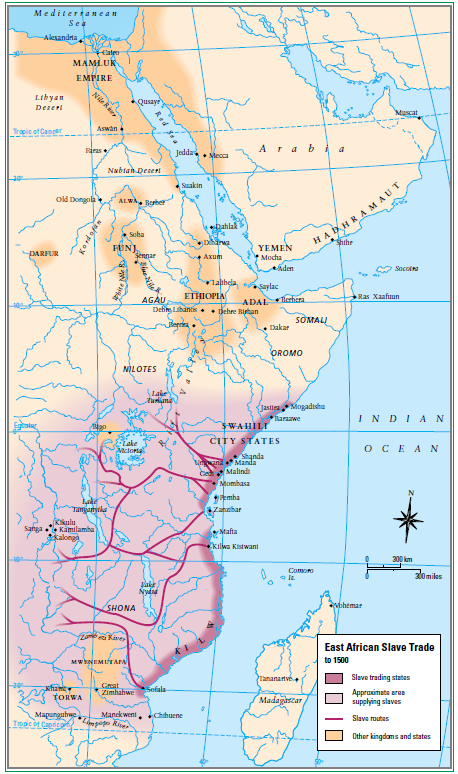
After Vasco da Gama rounded the Cape of Good Hope in 1498 the Portuguese systematically destroyed the prosperous Swahili cities that had sprung up along the coast. In 1505 Kilwa was captured and Mombasa was sacked. By 1530 the Portuguese controlled the entire coast from their fortresses on Pemba, Zanzibar, and other islands. In the 1650s, however, the Omanis who were Ibadi Muslims expelled them from Muscat, restoring the eastern part of the Indian Ocean to Muslim rule. The Omanis built up the trade in cloth, ivory, and slaves between East Africa and India. In the nineteenth century, under the sultan Sayyid Said bin Sultan (1804–56), Muscat and Zanzibar were briefly united under a single ruler, opening the way to settlement by new waves of Muslim immigrants from South Arabia. Much of Zanzibar was turned over to the commercial production of cloves and other spices, using slave-plantation methods similar to those employed in the United States. After the division of the empire between the sons of Sultan Said, Zanzibar came under increasing pressure to abolish the slave trade by the British, who used their navy to enforce the antislave trade laws and to pursue their own commercial interests. After becoming a British protectorate, Zanzibar played host to a new wave of immigrants from British India. Many of these migrants were Muslims from minority communities including Momens, Ithnashari Khojas, and Ismailis.
|
 |
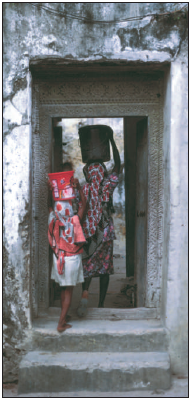
The entrance to a private house in Stone Town, Zanzibar. The decorated portals carved from local hardwoods or trees imported from the mainland symbolized the social status of the house’s owner. The walls are made from coral rag and need constant maintenance to prevent destruction by torrential monsoon rains.
|
| Back to Table of Contents |
|
