| The Ottoman Empire became the most far reaching of all the Islamic states. It began its remarkable expansion as a frontier state conducting raids on Byzantine territories from Bithynia near the Sea of Marmara early in the thirteenth century. In 1242–43 the Mongols defeated the Saljuqs, making them vassals, and pushing increasing numbers of Turkish nomads into the peninsula in search of pasturage and booty. The breakup of Saljuq power led to the creation of several petty states under loose Mongol overlordship. After taking Bursa, which they made their capital in 1326, the Ottomans became players in the factional strife that beset the Byzantine Empire in its latter days. It was as auxiliaries to one of the contending parties that they first crossed the straits and occupied Byzantine territory in Europe. They occupied Greece, Macedonia, and Bulgaria, and finally established their control over the western Balkans by defeating the Serbs at the Battle of Kosovo in 1389. Successive campaigns involving coalitions of Latin and Orthodox powers (including Naples, Venice, Hungary, Transylvania, Serbia, and Genoa) failed to stem the Ottoman advances into Europe. In 1453 Constantinople fell to the forces of Mehmet the Conqueror, fueling Ottoman imperial ambitions and providing the basis for further expansion. In 1521 the Ottomans captured Belgrade from the Hungarians. By 1529 they had reached the gates of Vienna, the Habsburg capital. By the time of the death of Suleiman the Magnificent in 1566 they controlled a swath of European territory from the Crimea to southern Greece. |
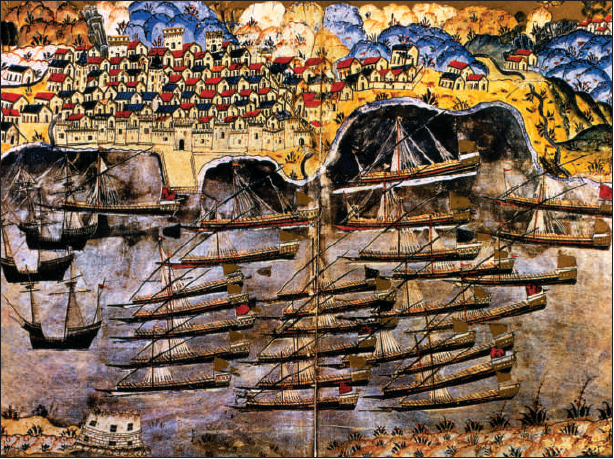
The great period of Ottoman expansion occurred during the reign of Suleiman I “the Magnificent.”
The painting above depicts an Ottoman fleet attacking the French town of Toulon in 1545.
|
| Ottoman victories were even more spectacular in the lands of Islam. After defeating the Safavids at Chaldiran in 1514, the Ottomans annexed eastern Anatolia and northern Mesopotamia, enabling them to control the central Asian trade routes linking Tabriz and Bursa. In 1516 and 1517 they took over the Mamluk Empire in Syria and Egypt, giving them control of the holy places of the Hejaz. Building on the Greek seamanship acquired from their Byzantine predecessors, they contested the power of Venice in the eastern Mediterranean and challenged the dominance of Habsburg Spain in the western Mediterranean, taking Algiers (1529), Tunis (1534–35), Jerba (1560), and the strategic island of Malta, the last Crusader stronghold, in 1565, as well as Cyprus in 1570. This string of naval victories finally provoked a successful counterattack. In 1571, the defeat of the Ottoman navy at the Battle of Lepanto by a Venetian–Habsburg coalition was celebrated all over Europe as a triumph for Christendom. Although the Ottomans refurbished their fleets and retook Tunis in 1574, a balance of power was achieved in the Mediterranean, confirming the frontiers that remained between the Muslim lands to the south and Christian lands to the north. |
|
| Back to Table of Contents |
|
