| Islam is an Arabic noun from the verb aslama, to surrender oneself. In its primary sense the active participle muslim means someone who surrenders himself or herself to God as revealed through the teachings of the Prophet Muhammad (c. 570–632). Muhammad is believed by Muslims to have communicated God’s revelation in the Koran, a text Muslims regard as the final revelation of God to humankind. Collected under the third of Muhammad’s successors, the Caliph Uthman (r. 644–656), the Koran is composed of 114 chapters, or suras. These are said to have been revealed in Muhammad’s native city of Mecca, where he was a respected merchant, and suras also date from the period of his sojourn in Medina (622–632). |
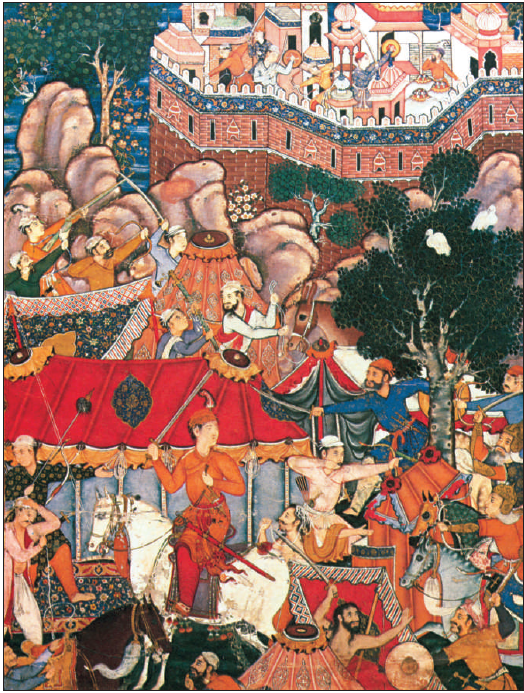
Although Muhammad’s image is considered taboo, pictures of the heroic deeds of his uncle, Hamza, and others were circulated to show the first epic battles of the Muslims. This painting from India c. 1561–76 is from a series of large-format illustrations shown to audiences while the epic stories were read aloud.
|
| In Mecca, the Koran’s condemnation of the sins of pride, avarice, and the neglect of social duties, its warnings of divine judgement, and its attacks on pagan deities brought Muhammad and his followers into conflict with the leaders of his own tribe, the Quraish. His fellow clansmen were boycotted, with Muslim converts subjected to persecution, and a number took refuge in Axum (Ethiopia). However, Muhammad’s fame as a prophet and trusted man of God spread beyond Mecca. He was invited to act as judge and arbitrator between the feuding tribal factions of Yathrib, later renamed Madinat al-Nabi (“the city of the Prophet”), usually shortened to Medina, an oasis settlement about 250 miles northeast of Mecca. The hijra (migration) of the Muslims in 622 marks the beginning of the Muslim era. The passages in the Koran dating from the Medina period, when Muhammad was the effective ruler, contain some of the legislative material (such as rules regarding marriage and inheritance) that would form the basis of what became Islamic law. After a series of campaigns against the Meccans, the Muslims emerged victorious. In the last year of his life Muhammad returned in triumph to Mecca, receiving the submission of the tribes along the way. He reformed the ancient ceremonies of the hajj (pilgrimage), discarding their animist aspects and reorienting them to what he believed to be the original monotheism of Abraham. After further expeditions he returned to Medina. He died there after a short illness in 632 |
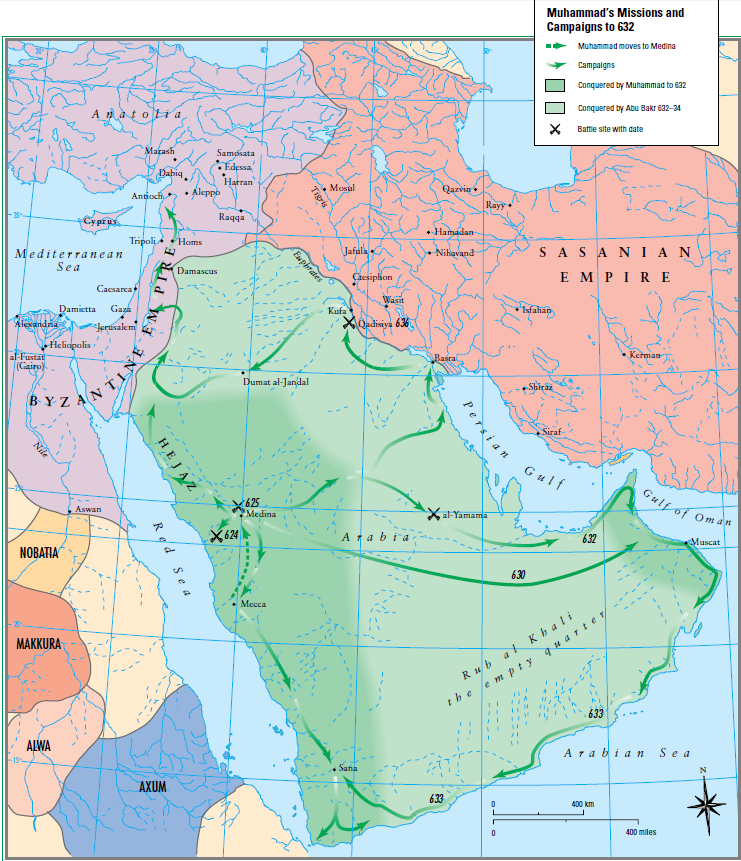
Muhammad’s Missions and Campaigns to 632
|
| Back to Table of Contents |
|
