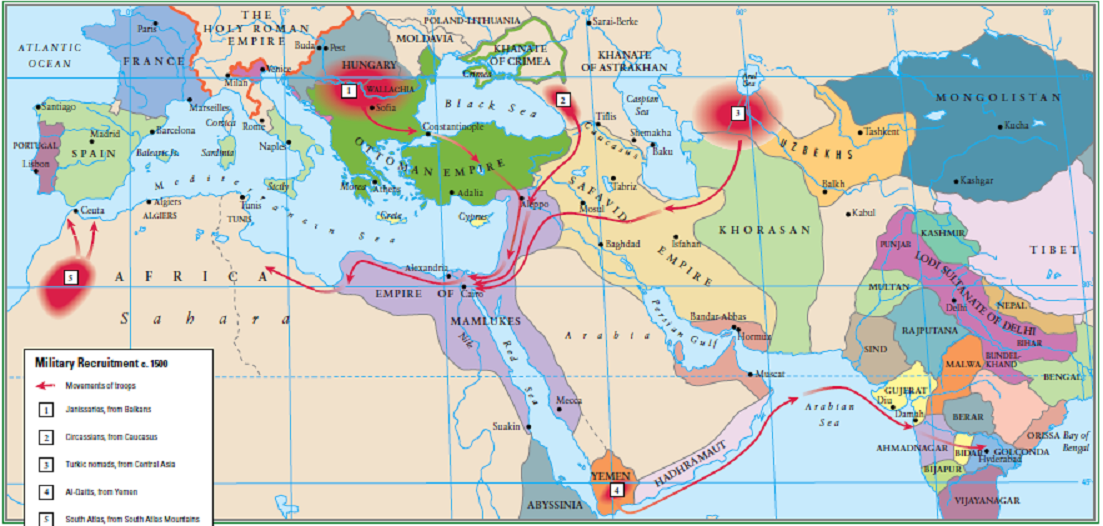
| The recruitment of armies from the peripheral regions, mainly from the steppelands of inner Asia, the Caucasus, and the Balkans, became the most distinctive feature of the Islamic systems of governance until modern times. Known as mamluks — “owned ones” — these warriors were purchased as slaves from the highlands and steppes or captured from defeated tribes. Brought in as the sultan’s private armies and palace bodyguards, they were taught the rudiments of the Islamic faith and culture and trained in the military arts. Attaching the word “slave” to mamluks (as in “slave-warriors” or “slave-dynasties”) is somewhat misleading. Though mamluks and ghulams (household slaves) were bought and sold as personal property, their social position reflected that of their masters, rather than their own servile status. Eventually manumitted they became freedmen, clients of their former masters entitled to property rights, marriage, and personal security, with some of them rising to become rulers. |
The practice of mamlukism started with the Abbasid caliphs, who recruited tribes from Transoxiana, Armenia, and North Africa to offset the power of the Tahirids. They balanced these tribes with Turkish ghulams who were purchased individually before being trained and drafted into regiments under individual commanders. Since they were housed in separate cantonments, with their own mosques and markets, their allegiance was to their commanders, rather than to the caliphs. In the breakup of the empire after 945 the practice was adopted by the defacto rulers who inherited the political power of the Abbasids. All the post-Abbasid states in the East — the Buyids, Ghaznavids, Qaraqanids, and Saljuqs — were created by ethnic minorities, including mercenaries from the Caspian region, and Turkish and other nomadic peoples from inner Asia. Since new military rulers had no ethnic, cultural, linguistic, or historical connection with the peoples over whom they ruled, society tended to develop outside the purview of the state, with the ulama — the religious scholars and experts on law — merging with merchant and landowning families to form elites of notables whose prestige was dependent on religious knowledge. While allowing a form of civil society to develop separately from the military state, the practice of mamlukism militated against the type of communal loyalties or patriotisms that would emerge in Western Europe at a later period. The pattern of recruiting erstwhile nomadic predators to defend society against other nomads — of making “wolves into sheepdogs” — is found throughout the Muslim heartlands, from the Maghreb to the Indus Valley.
|
| The system of military slavery reached its fullest development in Egypt, a densely populated country of peasant cultivators without an indigenous military class. The system was institutionalized so successfully that mamluk rule lasted for more than two and a half centuries (1250–1517), and resurfaced in a modifed form under the Ottomans (1517–1811). By constantly replenishing their ranks from abroad (firstly from among the Kipchak Turks from Central Asia, later from among the Circassians in the Caucasus) the Egyptian mamluks resisted becoming absorbed into the ranks of the indigenous elites. For the most part they remained a one-generation aristocracy, without ties of blood to the rest of Egyptian society. |
 |
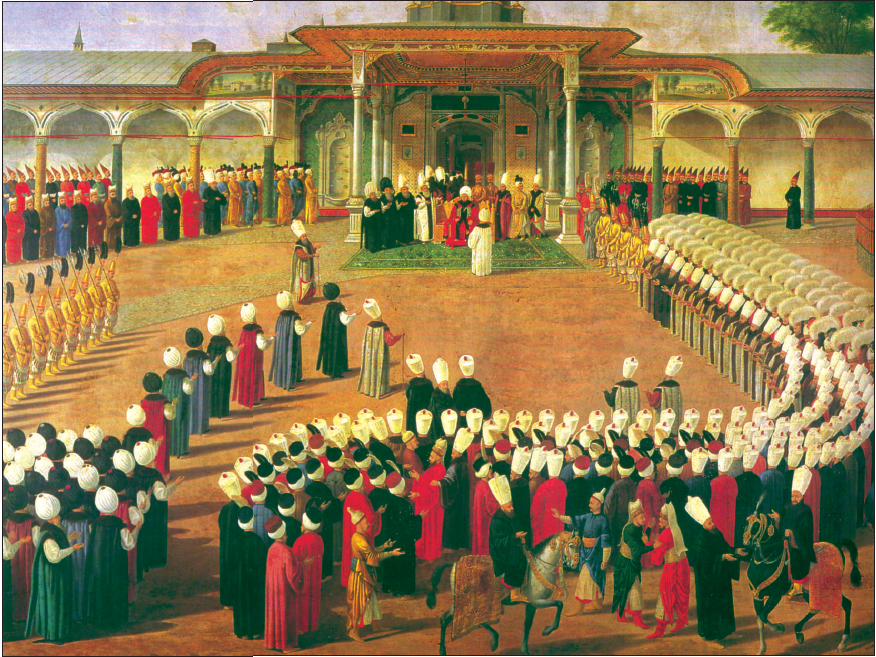
| Under the Ottomans military slavery evolved in a somewhat different direction. From the late fourteenth century the sultans began to offset the power of their sipahi cavalry units levied from the estates of the nobility or recruited as mercenaries from Arabic, Kurdish, and Farsi-speaking nomads, an infantry corps of “new troops”, Janissaries, levied mainly from its Christian provinces in the Balkans. The levy (known as the devshirme) was conducted in the villages about every four years: the towns were usually exempt, as the sons of townsfolk were considered too well educated or insufficiently hardy. Boys between 13 and 18 were selected (although there are reports of children as young as 8 being chosen). Since married men were exempt, the Orthodox peasants often married off their children very young to avoid the levy. The selected boys (estimates are put at around 20 percent) were given Muslim identities and trained in the arts of war, with the brightest selected for personal service to the sultan, where they often rose to be rulers of the empire. Although slave recruitment ceased in the 1640s the Janissaries continued to prosper, with increasing numbers of Muslim-born boys joining their ranks. Having substantial commercial interests, salaries, and state-funded pensions they became a privileged and tyrannical elite, resistant to change. In 1826 Sultan Mahmud II used his newly formed military force to slaughter most of them at a muster in Istanbul. |
The Janissary corps, dressed in their gold finery, parade at a court reception. Originally recruited from the Christian Balkans, the Janissaries became a formidable power within the state. Sultan Mahmud II abolished the Janissaries in 1826, as part of his program of modernization.
|
| Back to Table of Contents |
|