| Al-Andalus is the Arabic name for territories in the Iberian Peninsula that came under Muslim rule and influence for nearly 800 years. The first Muslim contact with the region came in 711. A Muslim army crossed the Straits of Gibraltar from North Africa and by 716 a number of cities and kingdoms had been defeated. The nature and extent of Muslim rule in the area was dramatically affected by the collapse of the Damascus based Umayyad dynasty in 750. A member of the family fled to Spain, becoming a governor before initiating a new Umayyad dynasty, which eventually declared Iberia and North Africa as a separate caliphate. Inspired by a more orthodox vision of Muslim rule, the two movements arriving in North Africa established control over the region in the eleventh and twelfth centuries. They were the Almoravids (1056–1147) and the Almohads (1130–1269). By the end of Almohad rule, various Christian rulers had united to begin the period of reconquista. Except for the rule of the Nasrids in Granada until 1492, most of the Iberian Peninsula was lost to Muslim authority. |
After the 1492 defeat of Granada, most Muslims and Jews fled to North Africa to avoid the Inquisition. Some submitted and converted to Christianity, while a small number were allowed to retain their faith, but under much more constrained circumstances. By the sixteenth century, however, the process of conversion and expulsion of Muslims was almost complete and the presence of Islam in the region remained only through cultural traces.
|
| The civilization engendered in Muslim Andalusia was linked to the broader developments in the Middle East and North Africa, but was distinctive in several respects. The art and architecture associated with the cities of Córdoba, Granada, Seville, and Toledo remain as landmarks. The literary heritage that flowered in the later period was also distinctive in its contribution to Romance literature. But perhaps the most enduring legacies were reflected in the philosophical, theological, and legal writings of Muslims and Jews, which would exercise a great influence on subsequent Latin scholasticism in Europe. Among this tradition’s most outstanding reference points were Ibn Rushd (also known as Averroës), who died in 1198 and Ibn Arabi (d. 1240), who wrote many mystical works that influenced succeeding generations. The great Jewish thinker Moses Maimonides (d. 1204) also worked in this most intellectually invigorating and culturally resplendent milieu. |
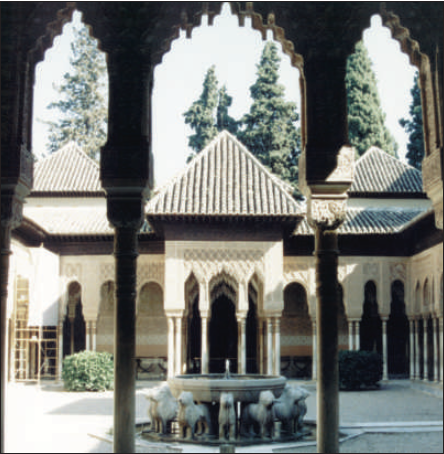
The court of the lions in the Alhambra palace in Granada. The kingdom of Granada, the last Islamic outpost in Western Europe, held out for 250 years in the face of the Christian Reconquista. Despite the external pressures, under the Nasrid dynasty it remained a sophisticated and tolerant center where Islamic and Western cultures were blended in a brilliant, creative synthesis.
|
 |
| Back to Table of Contents |
|
