| The Shiite Ismaili caliphate of the Fatimids was established in Ifriqiya in the Maghreb when a group of Kutama Berbers accepted the claims of Abdallah al-Mahdi to be the rightful descendant of Ali and Fatima and rose against the Aghlabids in 909. By 921, al-Mahdi had settled in his new capital city of Mahdiyya on the coastline of Ifriqiya. As successors to the Aghlabids, the Fatimids also inherited their fleet and the island of Siqilliyya (Sicily). By the end of al-Mahdi’s reign (909–934), the Fatimid state extended from present-day Algeria and Tunisia to the Libyan coast of Tripolitania. The third Fatimid caliph al-Mansur (r. 946–953) built a new capital city named Mansuriyya after himself. Situated near Sabra to the south of Qayrawan, Mansuriyya served as the Fatimid capital from 948 until 973. |
Fatimid rule was firmly established in North Africa only during the reign of the fourth member of the dynasty al-Muizz (r. 953–975), who transformed the Fatimid caliphate from a regional power into a great empire. He succeeded in subduing the entire Maghreb, with the exception of Sabra, before concerning himself with the conquest of Egypt, an objective attained in 969. A new Fatimid capital city was built outside Fustat; it was initially called Mansuriyya, but renamed al-Qahira al-Muizziyya (Cairo), “The Victorious City of al-Muizz,” when the caliph took possession of his new capital in 973. The extension of Fatimid power in Syria became the primary foreign policy objective of al-Muizz’s son and successor al-Aziz (r. 975–996). By the end of his reign, the Fatimid Empire had attained, at least nominally, its greatest extent, with Fatimid suzerainty being recognized from the Atlantic and the western Mediterranean to the Red Sea, the Hejaz, Syria, and Palestine. By 1038, the Fatimids had also extended their authority to the emirate of Aleppo.
|
| In the long reign of al-Mustansir (1036–94), the Fatimid caliphate embarked on its decline. Northern Syria was irrevocably lost in 1060. By then, the Fatimids were confronted with the growing menace of the Saljuq Turks, who were laying the foundations of a new empire. In 1071, Damascus became the capital of the new Saljuq principality of Syria and Palestine. By the end of al-Mustansir’s rule, of the former Fatimid possessions in Syria and Palestine, only Ascalon and a few coastal towns, like Acre and Tyre, still remained in Fatimid hands. By 1048, the Zirids, ruling over Ifriqiya on behalf of the Fatimids, placed themselves under Abbasid suzerainty. By 1070, when they lost Sicily to the Normans, Barqa had become the western limit of the Fatimid Empire, which soon became effectively limited to only Egypt. Ascalon, the last Fatimid foothold in Syria-Palestine, was lost to the Franks in 1153. Fatimid rule ended in 1171, when Salah al-Din (Saladin), who became the last Fatimid vizier after taking over Egypt, had the khutba (sermon) read in Cairo in the name of the reigning Abbasid caliph while the last Fatimid caliph, al-Adid (r. 1160–71), lay dying in his palace. |
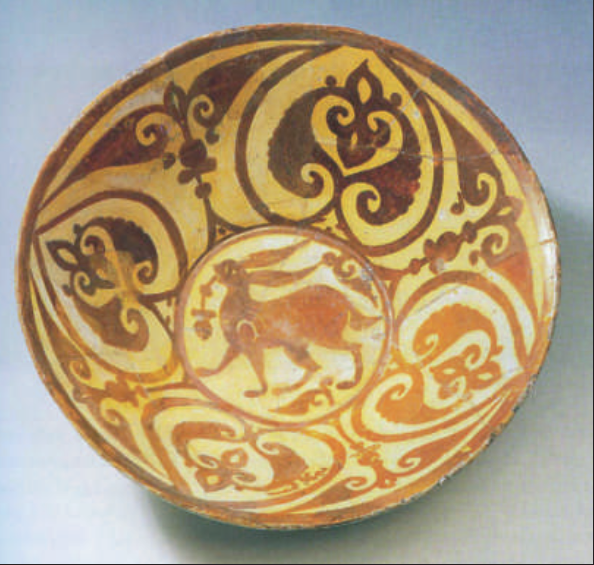
Ceramic bowl from Fustat (Cairo), tenth–eleventh century. The lusterware design has characteristically Fatimid motifs, with a hare at the center and the sides decorated with stylized plants. |
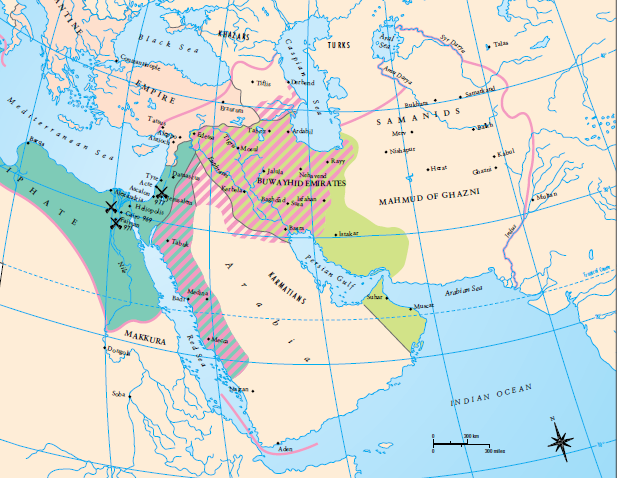
Fatimid Empire and other Islamic States c.1000
|
| Back to Table of Contents |
|

