| Islam expanded by conquest and conversion. Although it was sometimes said that the faith of Islam was spread by the sword, the two are not the same. The Koran states unequivocally, “There is no compulsion in religion” (2:256). Following the precedent established by the Prophet, who allowed the Jews and Christians to keep their religion if they paid tribute, the caliphs granted all the people of the Book (including Zoroastrians) the right to maintain their religious practices provided they paid the jizya tax (tribute), a payment in lieu of military service. Initially Islam remained the religion of the Arabs, a badge of unity and mark of superiority. When conversions did occur the converts were required to become mawali (clients) of the Arab tribes, the assumption being that the Arabs retained a hegemonic role. |
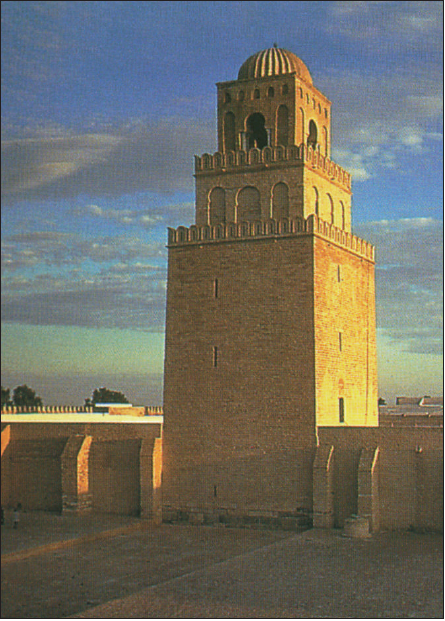
The tower of the great mosque in Kairouan, now in Tunisia, dates from the ninth century. Built near the site of ancient Carthage, the design of three superimposed towers is based on the lighthouses and watchtowers of classical antiquity.
|
Many factors, however, encouraged conversion after the initial conquests. For those Christians who were tired of centuries of erudite theological wranglings over the precise balance between Christ’s divine and human natures, Islam provided the hospitality of a religion in which Christ had an honored place as a forerunner to Muhammad. Likewise for Jews Islam could appear as a reformed faith in the tradition of Abraham and Moses. Zoroastrians, deprived of state support for their religion after the Arab conquest of the Sassanian Empire, would find in Islam a religion, like theirs, of individual ethical responsibility and later, in the Shiite idea of a Mahdi (messiah) from the House of Ali, a concept similar to the Saoshyant of Zoroastrian eschatology. Messianic ideas have a universal appeal, and are found in nearly all religious traditions. After the Islamic conquests in India, the Awaited Imams of the Shiite eschatology would sometimes be identified with a forthcoming avatar of Vishnu. In the metropolitan areas converts from the older traditions helped to detribalize the Arabian religion by asserting their rights as Muslims, by emphasizing the universality of its message, and by stressing its legitimizing function in the establishment of the new social order and forms of political power. Further afield the simplicity of the conversion process (the mere utterance before witnesses of the formula: “There is no god but God. Muhammad is the Messenger of God”) would contrast favorably with the often complex conversion procedures of the mystery religions. In Subsaharan Africa local spirits could be Islamized by incorporating them into the Koranic storehouse of angels, djinns, and devils. Ancestor cults could be accommodated by grafting local kinship groups onto Arab or Sufi spiritual lineages. |
| There were also more worldly considerations behind many conversions. Islamic marriage rules are weighted in favor of spreading the faith, for while a woman from one of the ahl al-dhimma (protected communities) who marries a Muslim is not required to change her religion, the converse does not apply, and the children are expected to be brought up as Muslims, ensuring the Islamization of subsequent generations. This demographic advantage would have carried considerable weight in societies where it was customary for the victors to marry the women of defeated tribes. More generally, there exists the natural tendency of bright and ambitious individuals to enter the ranks of the ruling elites. As Islamic society developed in metropolitan areas such as the cities of Iran and Iraq, knowledge of the Law and the Traditions of the Prophet, alongside secular learning in such fields as literature, astronomy, philosophy, medicine, and mathematics, became the mark of distinction among the patrician classes. Conversions inspired by social ambition should not be dismissed as mere opportunism: at its high point in the classical era, the Islamic world was the most developed and sophisticated society outside China. The models of urbane sobriety and order it offered would have exercised their own appeal quite apart from conscious missionary activity. Peoples on the fringes of the core regions would have encountered the faith in numerous guises: educated, literate merchants, wandering scholar-teachers, charismatic dervishes, native princes with impressive retinues, sophisticated intellectuals and dais (missionaries) from esoteric traditions who specialized in tailoring their message and rituals to suit audiences of widely different cultural backgrounds. Lacking a centrally directed missionary program, the religion has proved itself sufficiently adaptable to spread organically. |
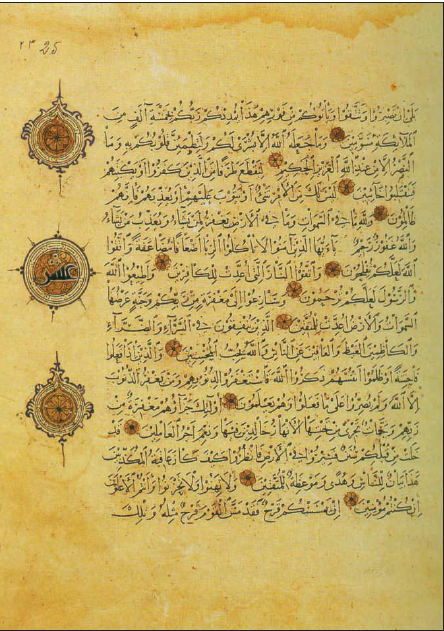
This Koran, written using muhaqqaq script, was produced in Baghdad in 1308. The large format indicates that this manuscript was a presentation copy, used for public recitation in the mosque.
|
| Back to Table of Contents |
|
