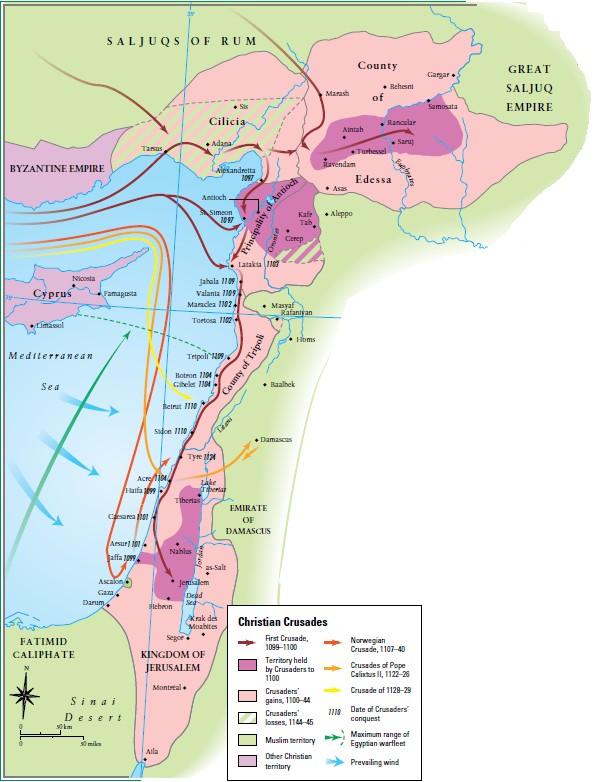
| The Crusades occurred at a time of Islamic disunity and retreat. There were Christian advances in Spain — Toledo fell in 1085 — and in Sicily, which the Normans conquered in 1091–92. Economically, the decline of the Abbasid caliphate and the Saljuq invasions had diverted the East Asian trade away from Baghdad and Constantinople. Sending it through Egypt and into the hands of Italian merchant shipping, it enriched the Italian cities. Harassed by Muslim pirates, Pisa and Genoa destroyed Mahdia, the political and commercial capital of Muslim North Africa in 1087. The fluctuating frontiers between the Byzantine and Fatimid Empires allowed the cities of Syria and Palestine considerable autonomy, making it difficult for them to unite against the invaders. The defeat of the Byzantine army at Manzikert in 1071 opened the rich Anatolian pastures to migration by bands of Oghuz Turks, not all of them under Saljuq control. Alarmed at the danger to Christendom posed by the Turks as well as by Norman attacks on Byzantine lands in Italy, Pope Urban II launched a Holy War for the defense and unity of Christendom. The movement was stimulated by charismatic, populist preachers such as Peter the Hermit and by the growing popularity of the pilgrimage to Jerusalem as a way of earning spiritual merit or as an act of atonement for sins such as murder. |
In the event, the knights from the Latin West, (including England, Scandinavia, Germany, Italy, and France) supported by ragtag armies of townsfolk and peasants lured by the promise of indulgences, were not wholly interested in saving Christendom by helping their Orthodox brethren. (They actually sacked Constantinople in 1204, inflicting untold damage on the capital of Eastern Christianity.) They wanted to carve out feudal domains in the well-watered lands of the Mediterranean littoral. The remarkable success of the First Crusade, culminating in the capture of Jerusalem from the Fatimids in 1099, contained the seeds of the Byzantine Empire’s eventual demise. The need to support the intrusive Latin states whose existence depended on Muslim disunity overrode the need to maintain Byzantium’s eastern frontiers. For the most part the Franks, as the invaders were known, were hated as oppressors by Muslims and local Christians alike — not to mention the Jews, who lost the protection they had enjoyed under Muslim rule, and were massacred in Palestine as they had been in Europe. Far from checking the Turkish advance on Christian domains, the Crusaders’ attacks on Byzantium helped to destroy the only polity that could have prevented it. Though the Latin kingdoms were eventually eliminated, their existence damaged the previously good relations that had existed between the eastern churches, their Muslim protectors, and local Islamic communities, leaving a legacy of mistrust of the West that has lasted to the present.
|

Entry of the Crusaders into Damietta, Egypt, in June 1249. After losing Jerusalem, the Crusaders made several attacks on Egypt in the hope of regaining territory in the Holy Land. From an illuminated manuscript painted in Acre shortly after 1277. This school of illuminators was probably founded by Louis IX during his stay in Palestine, 1250–54. |
|
| Back to Table of Contents |
|